“The city is a museum,” Fernando told me. “If you dig a hole deep enough anywhere you will find something.”
We were standing in the middle of what was Ancient Rome’s city center. All around me stood remnants of columns and stone foundations – none of which I would have had any hope of deciphering if not for Fernando, who explained the various layers (literally) of history we were standing on top of in terms that I could hold onto and appreciate.
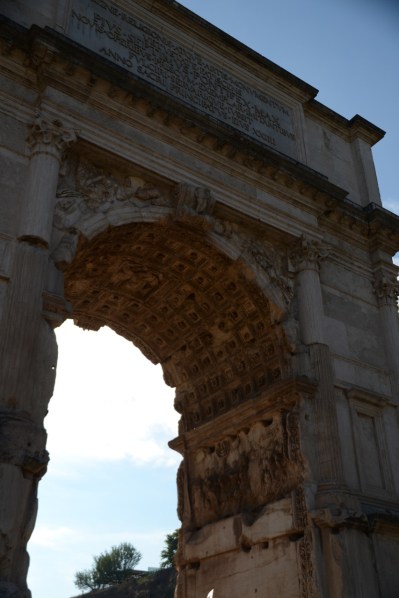 He likened the city to a lasagna: each time it was wiped out for one reason or another, the next iteration was simply built on top.
Fernando, a short Sicilian man with a mop of dark curls, is an archeologist who, shortly after earning his PhD, had to put down his life’s work in exchange for leading people like me past the very site he’d spent so many months excavating. “The economy is not so good for archeologists right now,” he explained with a sad shrug. When we asked how it was he became interested in archeology, he told a short story about a trip to Egypt when he was nine. His tone of voice made me wonder if he viewed the discovery of his true passion as was one of the more unfortunate events of his life. One has to question if the economy will ever be ‘good’ for archeologists.
Fernando spoke knowledgeably of the emperors and the gods and the customs and the beheadings – positioning it all as if it were interesting tidbits of gossip. I was utterly enthralled. He also talked openly (though in a quieter voice) about his disdain for Italy’s poor preservation of history. As we walked past a new metro line under construction beside the Colosseum, he explained that the builders are obligated to provide proof that they will dig deep enough so as not todisturb any ruins. But Fernando said that was ludicrous – there was no way to know how deep the ruins go at any point. “It’s a constant struggle between people who want to give money to the past, and those who want to invest in the future,” he said. There was no doubt in my mind which ‘people’ he sides with.
For us, Rome has been a two-part story.
We first arrived well over a week ago with the sole intention of applying for Indian visas at the embassy, then renting a car and heading toward the Amalfi Coast. The later was blissfully successful; the former: not so much.
My initial impression of Rome was that it is a city that makes no attempt to put on airs. If Paris is the homecoming queen, Rome is the stoner ‘C’ student. A layer of grit coats just about everything here, but in a way that gives the city a truly ‘lived in’ feel. I quite like it.
Our first guesthouse was run by a man named Fabrizio, who welcomed us with open arms (literally), an animated smile and an eagerness to point out on a map everything we needed to know about getting anywhere we could possibly need to go. I was beyond starving and could have stopped him at “You must try my friend’s restaurant, tell him Fabrizio sent you!” but I listened patiently. It is people like Fabrizio who have often made all of the difference on this trip. In a place we had no business being, he made us feel like we belonged.
When we returned to the city after the Amalfi Coast, it felt almost familiar, even though we’d barely been there 36 hours the first time. A week caused a distinct shift in the sunlight’s angle: it is solidly Autumn here. The days are warm, but by 6:30 it is cooling down. I’ve run every evening along the grey-green river that moseys through the center of the city – each time making a mental note to thank my father for convincing me to pack a proper pair of running shoes. “People run all over the world,” he told me. “I think you’ll be surprised.” I’ll say for the European world (or what little I’ve experienced) he’s been correct. Running has been core to helping me feel like myself these past few weeks and often, when David and I exchange our ‘high / lows’ of the day, my run has been the former.
On our second night in Rome we craved something – anything – that was not italian food. This was harder to find than I would have thought in a city this size, but maybe I wasn’t looking hard enough. As it turned out, our guesthouse is conveniently located in the same neighborhood as one of the city’s few reputable sushi restaurants (though I would have gladly gone many a kilometer for it). The place did not disappoint. When the server set down the first platter of fish – those tiny slabs of tuna so gorgeous – David and I asked in unison if there was any wasabi to be had. I’d been craving something spicy for several weeks.
In fact, my craving for something ‘different’ has extended far beyond my dinner plate.
A state of restlessness originally began back in Florence and persisted throughout the Amalfi Coast and Rome. Europe has been lovely. Gorgeous and memorable and all-around easy. After my initial encounter with the language barrier in Paris, I haven’t found much else challenging. In that way, this has felt something like an extended holiday – which I suppose, in a way, is exactly what it is. But I – and David, too – crave something more. Would it be cliche to ask for a dose of culture-shock?
It had been our original intent that, after Italy, we would carry on to Slovenia, Croatia and Greece – all places I still desperately want to visit. I’ve heard amazing things – the photos are gorgeous, and I do so love being near the water. But, after one month and barely a country, it’s become abundantly clear that of all the places in the world we want to see, we likely won’t have time for three-fourths of them. So the question became: which do we want to see now, and which could we easily enjoy in the future?
This, I’m realizing, is the hazard of traveling without plans.
Tonight we head to Tanzania. First stop: Zanzibar.
Known for its scuba diving and spice market, I have to assume there will be a diversity in both flavors and observations. While it is with some trepidation that we venture to that specific corner of the world, according to the US Government’s Travel Safety website, my biggest concern should be about my baggage being stolen. And so, naturally, last night at dinner I recited to David the things I plan to stuff into my carry-on. “I think it’s going to be fine,” he said, in an effort to dismiss my neurosis. “I’m not worried about our bags.”
“I’m not either,” I told him. “Because everything I truly care about is going to be stored beneath the seat in front of me.”
Following Zanzibar we’ll fly up to Mt. Kilimanjaro where we’ll get a good look before heading out to the Serengeti. This all came together so quickly my head is still spinning. Together, David and I have become travel-booking whiz-kids. In the time it once took me to plan a weekend trip to Seattle, I can now book a safari in Tanzania, an airbnb and rental car in Cape Town, and approve a proposed itinerary from a travel company in Bhutan.
And so, last night we popped our first malaria pills and prepared to bid a final ‘ciao’ to Italy (and the western world at large). As future plans begin falling into place, I also find myself looking backward – particularly now that there is more to see. I seem to be in a never-ending cycle of nostalgia. Like Ancient Rome, fond memories of Paris were layered beneath equally fond memories of Cinque Terre, then Florence, then the Amalfi Coast. In fact, the one place I thought I’d feel the deepest longing for has barely come to mind. Home is a distant, distant memory – a place I know is still there but stands largely irrelevant in today’s grand scheme of things. I see the photos of San Francisco’s ‘summer’ light up my Facebook newsfeed, and I miss it – I genuinely do. But with travel has come a unique appreciation for where I am. Also, a patience.
Last night I ran beside the river for one final time before taking what will likely be a half-month hiatus from such activity (due to geographic constraints), fears crept in as they always do. There is a degree of uncertainty to our upcoming days, absolutely. But the fears felt like that phone call one has to make to the cable company. A thing not enjoyable to dwell on. And I quickly, easily, pushed it out of my mind, instead focusing on the river, the old soot-coated buildings, that ancient piece of bridge that connects to nothing and the electric energy of the city around me.
(For photos from the Amalfi Coast and a few from Rome, click here)


 Somewhere Seeking
Enjoy Zanzibar!
“People run all over the world” as if I really knew! I’ve hardly been out of Oregon and Nevada! Glad you are enjoying running. Craig