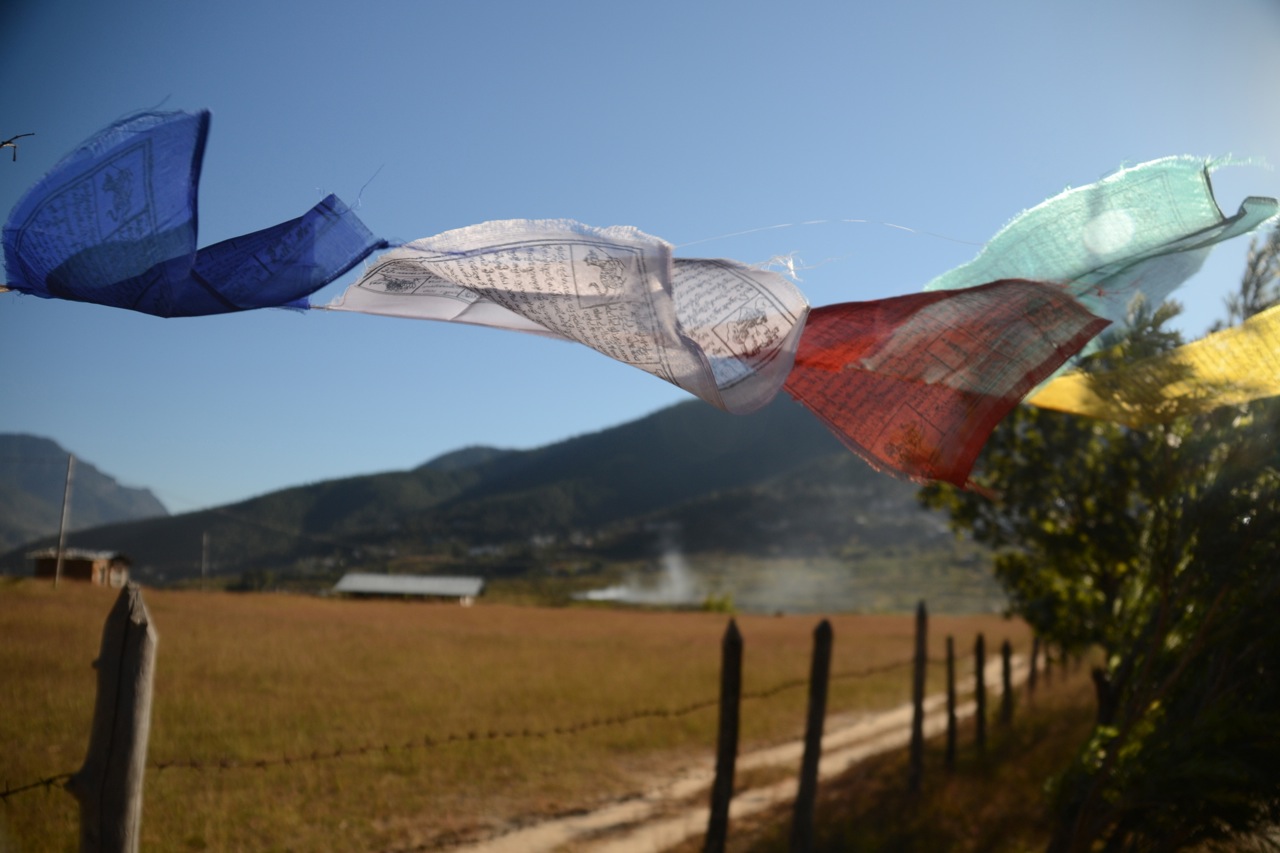
Bhutan, for whatever reason, decided to set up shop smack dab in the middle of the Himalayas. There isn’t a plain in site. The airport runway is couched in barely a valley where a dozen ridges collide, a predicament so unusual that the pilot warned us before the descent that we should not be alarmed if the mountains looked frighteningly close to the plane. Even still, when we banked suddenly to the left at a height where I expected to hear the reassuring hum of the landing gears I gripped the armrest and gasped “what’s going on!?” while David said simply: “Impressive.” Outside of the plane I understood the reason for our maneuver: we’d just shimmied over one of those dozen ridges that rise in spitting distance from the tarmac. Impressive, indeed.
While the rest of the world is out of breath trying to keep up with its perpetually-in-flux-self, Bhutan seems to have poured equal effort into staying exactly the same. The government mandates that many workers (government officials, tourist guides, etc) wear the national dress (for men this means a kilt-like robe called a ‘gho’), and new construction is to feature traditional elements such as intricately painted facades and ornately shaped window moldings. This, in addition to the traditional ways of life that Bhutanese people maintain of their own accord amounts to a sort of time machine effect that has transported me not only to another time but another world entirely.
Chili peppers dry on tin rooftops, round-faced babies are strapped to the backs of their mothers with colorful scarves, rice paddies are harvested with hooked blades by elderly women, and fields are plowed by duets of yaks. This is a world that is largely pristine and noticeably quiet. Even the capital city of Thimphu, 80,000 people strong, beholds the sleepiness of a ski town before the season’s first snow.


To the naked eye it might seem that the Bhutanese are behind the times, but another perspective is that they’re simply discriminating in what products of ‘the times’ they adopt. In some cases this is more due to circumstance, but the result is the same. We walked through one village that received electricity just one year ago. I saw no satellite discs on rooftops there and so feel fairly certain they are still largely insulated from western culture. But modern technology is indeed folding into the Bhutanese way of life in a way that was neatly epitomized by the man I saw exiting a temple in Thimphu the other day. Dressed in a gho he carried a roll of prayer flags in one hand and in the other an iPhone 5.
Bhutan has coined the phrase “Happiness is a Place,” and, while I’ve only been here a few days I’m hard pressed to disagree. At the very least: happy are the people. Bhutan’s government is famous for having made ‘happiness’ a measurable priority with its initiative ‘Gross Domestic Happiness,’ a thing the previous king ranked more important than Bhutan’s GDP. Bhutan has been ranked as the eighth ‘happiest’ country in the world and the ‘happiest’ Asian country – thought the cynic in me must also point out that in the running is Japan, whose people are such workaholics they’re known for dying on their morning commute. Even still, I haven’t met eyes with a single person here who hasn’t flashed me a smile in return.


The Bhutanese embody a happiness unlike anything I’ve seen before. A low-key, simple happiness – the sort that I suspect comes from having ones’ simplest needs met. In Nepal, everyplace I went I was asked for something. The most memorable of these instances was one morning when I was eating breakfast at an outdoor cafe. A little boy appeared next to the table, barefoot and covered in dust, wearing a man’s shirt that went down to his knees. Without hesitation he reached for a crumb of french toast that swam in honey on my plate. Then he asked me for water.
In Bhutan I haven’t seen a beggar and every single child looks thoroughly nourished. The country earns the bulk of its income from the sale of hydro-electric power to India, and the government here cascades that money into education, healthcare and other social welfare efforts in a manner that (I’ve been told) is shockingly absent of corruption. Everyone receives the education required to eventually support themselves and their family. People are trained as tour guides, teachers, mechanics and even artists. On the first day we toured the country’s Arts & Crafts School. While teenagers milled around on their lunch break, we ducked in and out of classrooms cluttered with impressive paintings, clay statues and carved wood. This vocation would seem like a dead-end, except that traditional art is present everywhere you go here. We toured a temple that was built just in 2003 and the dozens of ornately sculpted gods that held court there were clearly as new as the building.


The things that seem to bring the Bhutanese people happiness are not of the fleeting variety. This country appears largely absent of anything associated with personal wealth – I’ve not seen a single sports car on the road. Nobody wears designer brands; as far as I know, Armani does not make a ‘gho.’ Even homes that, from a distance, look like they must be mansions, are simple farmhouses when seen up close.
Yesterday we hiked to a small village whose people were busily preparing for an upcoming festival. In a courtyard I leaned against a cool stone wall and watched a group of young men rehearse a dance while villagers looked on. Children wandered in and out and elderly men with wiry beards watched with what I assume was a genuine joy. To see a tradition carried on another year, by another generation would fill a man with that, I think. While the men twisted and turned and leaped in accordance with a clanging cymbal I thought about how special it was to be observing. This was nothing like the dance I watched the traditional Maasai people perform back in Tanzania. I wrote here about how uncomfortable I felt, watching the Maasai people sing and dance for my benefit. But in Bhutan, in that courtyard in the village on the hill: they were dancing for themselves. They’d have done it whether I showed up or not.


Naturally, Bhutan has piqued the interest of tourists all over the world, and I imagine they would be coming here in droves if not for the high (exorbitant, really) daily tariff charged to visitors.
Each of us is in the required company of a guide, a practice that was politely explained to me as a way of ensuring we ‘properly experience the sites,’ but I know it is actually a form of chaperoning. It wouldn’t do to have misbehaving tourists trying to enter Temples wearing tube tops and leaving behind them a trail of cigarette butts and beer cans.
Kidding aside, Bhutan’s thoughtful approach to tourism is downright admirable. This gorgeous country simply would not be the same if double-decker tourist buses were winding along its emerald green mountainsides. Bhutan’s exclusivity is a major part of its allure.
Even still, I was concerned about this guide scenario; they can be so ‘hit-or-miss’ (as I explain in exhaustive detail in my previous post). But Dhana, our guide, is fabulous. His embodiment of Bhutan’s peacefulness plays out in the things he does (gentle regaling of the ancient myths painted on temple walls) and also the things he does not (attempt idle conversation during long car-rides). He is a wealth of information; there isn’t a single question he has not confidently answered, making him a valuable asset in my attempt to understand Bhutan on a level deeper than I have any of the other five countries I’ve visited on this aimless circuit.

Each morning we climb into the car with Dhana, and he gives us the rundown of the temples, museums and villages we’ll visit that day. Then we’re off, motoring along the one-lane road that somehow accommodates two-way traffic. I love the temples. I love the villages. But most of all: I love the drives. I love looking out the window at the forested mountains that ripple endlessly into the distance, and I love the thoughts that percolate in my mind.
Bhutan is the sort of place that will have you poking at the edges of your own happiness. The Bhutanese won’t pretend that their way is better; they won’t try to change your way of thinking. But don’t be surprised if that starts to happen anyway.


 Somewhere Seeking