I’m in Chiang Mai, Thailand, for approximately twenty minutes when I realize just what sort of place I’ve landed in. We’ve just come off of a weeklong ‘vacation’ from traveling: a much-needed (if not deserved) respite from sightseeing, guesthouse hopping, and zipping, zipping, re-zipping my enormous backpack. Koh Samui, in the gulf of Thailand, is where this occurred and it’s probably a beautiful island; I wouldn’t know. During my week spent on its northern beach, I saw little beyond my pink painted toes against a backdrop of a well-kept swimming pool, a trio of spindly palm trees and miles of turquoise sea. The most notable event of the week was our dive at the illustrious “Sail Rock,” where our charming dive-master Collin, a barrel-chested Scotsman, coaxed me closer to a giant eel than I’d ever intended to be.
So by the time we leave Koh Samui, I’m restless. I want to get up and do something. And Chiang Mai, if our cab driver is to be trusted, seems the place to do exactly this.
“Tiger Kingdom,” the driver says. He’s now pulled over to the side of the road and is describing various photographs behind foggy plastic sleeves of a three-ringed binder. I twist my face at the image of tourists cuddling with full-grown tigers; surely something is amiss here. “Cobra feeding,” he goes on, turning the page. Sure enough, there are cobras swallowing small animals. “Elephants!” He announces triumphantly, tapping his fingernail on a photograph of a droopy-eyed giant bearing a small family on his back.
I’ve never considered myself an ‘animal-lover.’ When it comes to the Eco-system, I care more about the disintegrating o-zone layer and that growing heap of trash in the Pacific than I do the extinction of the panda. But this doesn’t mean I’m not discerning about such matters.
“I don’t know about this elephant thing,” I say to David over breakfast the next morning. Our fingers are tripping over our computer keyboards, searching Trip Advisor for recommendations on ‘must-dos’ in and around Chiang Mai. Elephants are apparently a top-seller.
“Ok-ay,” he says. A question, not a response.
I’m looking at photos online of elephants painting pictures with their trunks in front of a group of tourists, an absurdly unnatural site to behold. I’m thinking, as has become common, about the role we as tourists play in local economies and environments. I’m thinking about my conscience. But I’m also thinking about the five days that roll out in front of us, big and baggy. We need to find something to do.
Chaing Mai is a bonafide ‘college town’ seated at the foot of modest green mountains.
An hour’s flight north of Bangkok and 1,000 feet of elevation make for a pleasant climate, while the river that cuts through the center of the city is enough to spur me out for a run each evening. “Sa-weti-cah” I say in greeting to the fishermen who squat beside the uneven dirt trail that I navigate. It is this daily run beneath an apricot-colored sunset that has me feeling downright at home in Chiang Mai. Between its plethora of coffee houses doling out delicious espresso, its boisterous nighttime markets and international food scene, it’s no surprise that so many western vagabonds choose to put up their feet for awhile in Chiang Mai. Travel, simply does not get any easier than this.
But back on day one, I’m still grappling with the task of understanding this new place. Elephants? Tigers? Cobras? Oh my. Chiang Mai is as approachable as it is a crowd-pleaser. Or maybe its no surprise that these things go hand in hand. For those who seek it, there is zip lining and paint balling and rafting and Australian college girls wearing short-shorts and tie-died tank tops. It’s a frat-boy’s wet dream, I’m thinking, and I try not to hold this against the place.
I start with the low-hanging fruit: a Thai cooking class, which raises no moral questions whatsoever and whose very nature suggests I might find myself among like-minded individuals. The words ‘organic’ and ‘farm’ make the decision easy and the following morning we’re picked up by a short Thai woman named Rika from Thai Farm Cooking School.
“We have lots of friends today!” she explains, her entire face stretching into one of the most beautiful smiles I’ve ever seen. I like Rika immediately. There are eleven of us, a mixture of Aussies, Spaniards and Americans, and we have two things in common: English and a taste for Thai food.
Over the course of the next several hours, Rika gallantly instructs on the creation of curry (a process, which begins with a giant stone mortar and pestle), Tom Yum soup, cashew chicken, Pad Thai, steamed vegetable spring rolls and the grand finale: sticky rice with mango. I’ll admit, I cringe a little bit when she pours the ‘coconut creamy’ into my curry. I hesitate with the bottle of oyster sauce and the fish sauce, too. These are items I’ve not cooked with before and they make me nervous, but they make the dishes taste delicious. These unusual additives aside, I’m surprised by the lack of oil used. Rika points this out repeatedly throughout the day: “Thai people like healthy food!” she sings, and somehow parlays this into a back-hand against the Chinese and their cuisine. I don’t disagree with her.


At one point in the curry-paste-pulverizing, a red chili pepper flies into David’s right eye. “Don’t touch it! Take off your left shoe,” Rika orders and he does. We all watch as she pours a stream of water onto his foot, and David swears to all of us that it works. He’s weeping out of his right eye while we all wonder if we’ve witnessed some sort of voodoo medical magic.
We’re returned to Chiang Mai with full bellies and a handful of new recipes. When it is I’ll be back in my sunlit-filled kitchen in San Francisco I’m not exactly sure, but for those of you with a kitchen close at hand, I’ve included below the recipe for green curry. More recipes from the Thai Farm Cooking School can be found here.


We do visit the elephants.
This after sufficient enough research that my conscience is placated. I run a Google search for ‘elephants, ethical, Chiang Mai,’ and surface the Elephant Nature Park. Founded by a woman named Sangduen Chailert, who was named, ‘Asian Hero of the Year’ by Time Magazine in 2005, the park is home to more than thirty elephants, all rescued from logging camps and trekking outfits. It is one of the few elephant parks near Chiang Mai which does not control the animals with bull-hooks (a thing I still don’t fully understand but the name is enough to make me wince). Instead, Sangduen has introduced a method of positive reinforcement familiar to domesticated pets all over the world: these elephants behave themselves for food.
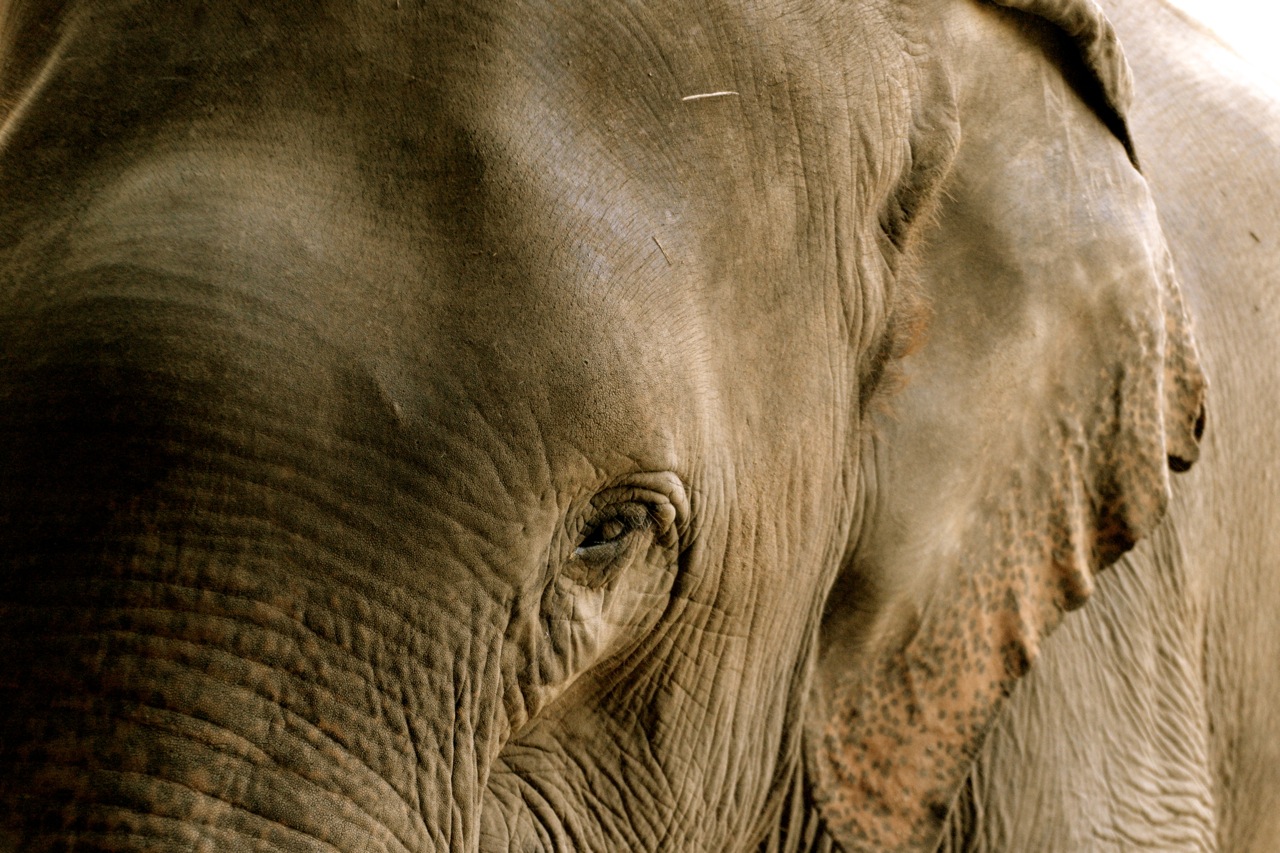
I get to participate in this ploy immediately upon arriving at the Elephant Park, a sprawling piece of land set in between lush hills that look like something out of the latest “Hunger Games” movie. A large basket of acorn squash is set at my feet while an elephant impatiently wags her trunk in a wide arch that nearly knocks me over, though not intentionally. She is blind, poor thing, and using her trunk like a dust vac searching the ground for lunch.


Again, I’m not an ‘animal lover’ in the classic sense, but the thrill of touching a creature I’d previously observed only from inside a safari vehicle is more than I anticipated. She takes the squash from my hand with a greediness, efficiently depositing it into her smiling mouth and reaching for another. I hear her crunch the hard shell of the squash as if its nothing more than a peanut, and I think of the many times I’ve battled those stubborn gourds with my sharpest butcher knife.
Throughout the day we meet many elephants. While we take turns feeding them bananas and petting their enormous ears our guide tell us about their individual histories, the saddest of these tales being Jokia’s. She was forced to work even when pregnant and while heaving logs up a hillside she gave birth to her baby. The loggers would not let her stop and so her baby rolled down the hill to its death. After this, Jokia refused to work (I can’t blame her) and this outraged the loggers (also understandable) so they shot her in the eyes with slingshots, blinding her permanently. Our guide points out the scars around her eyes and in unison we all let out a sympathetic sound. The happy ending to Jokia’s story is that here at the park she has been ‘adopted’ by another female elephant who stays in close proximity to her at all times. I wonder if I’m more of an animal lover than I thought…but really, Jokia’s story would pull the heartstrings of anyone. It does yours, right?


On our drive back to Chiang Mai we pass a man riding an elephant. I scowl at the way he smacks the animal on either side of its huge head with a big stick; a feeling of superiority swells within me. I now feel such sympathy toward the elephants and outrage toward the people who mistreat them…But the subject of ‘mistreat’ is perhaps not straightforward. The devil’s advocate in me wants to ask: should I care more about the animal than I do about the loggers who are trying to feed and clothe their families? Can one be an animal lover and a people lover, too? There are solutions to all of this, yes, but none of them perfect. And that is, perhaps, the thing I sympathize with most.
A few days later we leave Chiang Mai behind for a brief stop-off in Bangkok before flying on to Sri Lanka for Christmas. I know I have gotten only the smallest taste of Thailand. I hear there are trails to trek and quiet mountain roads to bike and miles of beaches to explore and it tortures me a little bit that I’m leaving without having done more. In Thailand I am made aware of how much there is to see in the world and I’m forced to accept that I won’t ever see half of it. Certainly not in six months. Not in a year. Not even a lifetime.
(For a few more photos from Chiang Mai and Bangkok, click here.)
GREEN CURRY
FOR THE CURRY PASTE:
2-3 green long chillies
1 tbsp. of chopped shallots
1 tsp. of chopped galangal
1/2 tsp. of chopped kaffir lime rind1 tsp. of chopped garlic
1 tbsp. of chopped lemongrass
1 tbsp. of chopped krachai ( or ‘Thai ginseng’ )
1/4 tsp. of roasted cumin seeds
1/4 tsp. of roasted coriander seeds
1/4 tsp. of salt ( or 1/2 tsp. of salt if you would like to keep the paste longer )
OTHER INGREDIENTS:
1 cup of sliced eggplants ( or other vegetables like cauliflower, broccoli or potato )
1/4 cup of smaller pea-like eggplants ( MAKHEAU PHUANG )
1/3 cup of sliced onion
70 grams of sliced chicken, beef, pork or tofu
1 tsp. of sugar
1 tbsp. of fish sauce or soya sauce
3 kaffir lime leaves
2 stems of sweet basil ( HORAPAA )
1 cup of coconut milk
1 cup of water
To prepare the curry paste, put all ingredients into a large mortar. Pound with the pestle until everything is mixed and ground thoroughly. You can also use a blender or food processor.
Pour the coconut milk into a sauce pot and turn to medium heat. Stir until oil appears. Add green curry paste and chicken and stir until almost done. Add your vegetables, water, sugar, fish sauce, salt and turn the heat up. Stir a little. When everything is cooked, put the sweet basil and lime leaves. Serve with rice.


 Somewhere Seeking