 Over these past six months of travel I’ve grown accustomed to many things I thought I never would. Non-potable water. Raw meat sold on street corners. Stray dogs that lunge and snarl at me when I’m out for a run. The filth and the confusion and the foreign languages…My eyes and ears glaze over these things.
But through it all there’s been one thing that has never ceased to catch my attention. One thing I have not been able to accept.
I wrote here about my experience in Myanmar: swarms of young children pleading with me to buy a postcard from them. The same thing played out in Sri Lanka, Nepal, Vietnam, Thailand and finally: Cambodia, where somehow it seemed more heartbreaking than anywhere else. There they wait for you just outside of the entrance to the ruins in Angkor Wat, holding baskets of trinkets you do not want to buy. They follow you back to your bicycle and they don’t let up. Smiling and responding with a polite ‘no thank you’ only encourages them so eventually you stop doing even that. You take on the attributes of a blind-deaf-mute person and you get on your bike and you get the hell out of there while the children, not missing a beat, move on to the next tourist.
Frankly, it’s child labor and it’s rampant in these countries where children are expected to contribute financially to the family – whether by working the fields or begging on the streets. Of course it is my western perspective that twitches uncomfortably at this idea. Relatively speaking, you could compare a seven year-old helping his parents in the fields to my childhood chores of emptying the dishwasher and raking leaves. But when these tasks prevent children from becoming educated (as is often the case in Cambodia), I can’t just accept that as a cultural difference. And judging by the number of NGO’s focused on providing education to children in developing countries, I’m clearly not alone.
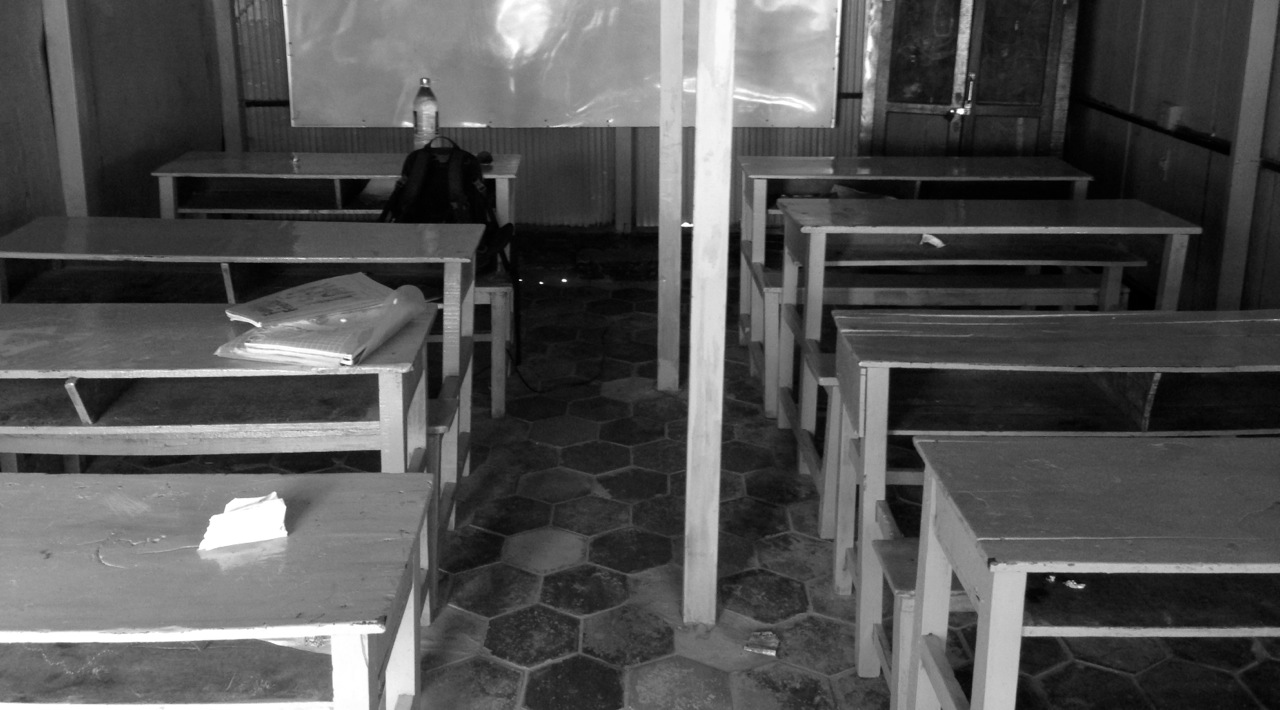
And so, a few weeks following my initial visit, I returned to Siem Reap – not to catch the sunrise over Angkor Wat one more time (spectacular as it was) but to stand beneath a struggling ceiling fan in a dim, ramshackle classroom located at ACODO, an orphanage just outside of town. Eight pairs of eyes looked at me with expressions of part curiosity and part nonchalant dismissal. I was one volunteer in a long line of volunteers and they knew I would not be there for long.
“Saturday?” An eight-year-old girl in the second row finally said tentatively, as if I might tell her she is incorrect – that no, Saturday is not her favorite day of the week.
“Good! Yes, Saturday,” I said, adopting an elementary-school-teacher voice I did not know I had. “Now how would you say that in a complete sentence?”
You’re probably not, but if on the off-hand chance you’re thinking me an exceptional person right now, I invite you to stop. Because my decision to spend a week in a sweltering classroom surrounded by grubby (but eager!) orphans was self-serving. Put simply, it made me feel really good to volunteer, and that I can openly admit that to myself and others only makes me feel that much better.
But yes, okay, also: I thought I could help. So you can imagine my surprise when I learned that I might have caused more harm than good. Wait, what?
According to experts and organizations such as Thinkchildsafe.org, short term volunteers can perpetuate potential attachment disorders…English speakers do not by default make good english teachers…And then there’s the fact that I supported an organization that technically employs questionable fundraising practices (to raise money and awareness, ACODO’s children perform a traditional Cambodian dance for tourists, which is not a far cry from child labor and indeed classifies as child exploitation). All of this equated to the opposite of what I was going for, and suddenly I didn’t feel quite so great about myself.
What initially drew me to ACODO was its shoestring approach (though I suspect that’s not actually by choice). I liked that it was founded and is run by Cambodians, not a flashy international NGO. I liked that they purported to serve children who would otherwise be forced into child labor – those trinket-selling vendors at Angkor Wat. I liked that instead of charging me the large fees of more mainstream ‘voluntourism’ projects, they asked me to donate as much as I felt comfortable. My money would go to help feed and clothe the children I’d become emotionally invested in.
When I arrived, I learned that not all of the children are actually orphans; some of them come from disadvantaged backgrounds. This is a trend throughout the unusually high number of ‘orphanages’ in tourism hot spots like Siem Reap and it raises more than just a few questions, the biggie being: are they above board?
A quick Google search answers my question: no, they are not. The Cambodian government claims to be performing audits. Investigations. They’re cracking down, but who knows what that actually means. Meanwhile, tourists flow through Siem Reap and tack an ‘orphanage tour’ onto their itinerary. They take pictures with the kids and they attend the dance performance and they drop a twenty dollar bill into the donation box thinking they’re doing the right thing.
Now, in my short time at ACODO I did not uncover any damning evidence that would suggest the organization is corrupt. All in all, the children seemed well cared for, clean and happy. Living at ACODO means they are able to attend formal school as well as receive English lessons from volunteers like me. They are a tight-knit community of motivated kids whose eyes lit up at my enthusiastic reaction whenever they selected the correct preposition (the cat sits in the tree, not on it). Each day they bounded into the classroom (relatively on time) and sat in their seats (relatively still) and together we pronounced sounds like th and ssss. Progress was made and my compliments appeared to sink in but in the end, their situation is still not perfect and I’m left feeling torn over whether ‘better than nothing’ actually is or is not?
Key to the relative success of my week at ACODO was a Cambodian university student named Malin. During the weeks when there are not native-English speaking volunteers, Malin takes the position beneath the struggling ceiling fan at the front of the room. His investment in the children is visible – and, oh yeah, he doesn’t get paid. After teaching my final class of the week, Malin drew me into a conversation about the state of ACODO – of Siem Reap – of Cambodia. He, too, saw the things that could be better and it didn’t take long before I realized that he wasn’t just venting – he was looking to me for some semblence of a solution. An idea.
The conversation went on for more than an hour. I drained my water bottle and began sweating profusely, fanning myself with a grimy spiral notebook. But still I talked and listened, talked and listened until the words began to sound familiar – we were repeating ourselves. I was stalling the end of the conversation because I knew exactly what it would look like. I would shrug my shoulders up into my ears and frown and tell him that I was sorry. That I didn’t know what to do. That I wished I could do more to help – give more time. And what made it all so much worse was that I actually could. I had more time to give and I chose not to. Truth be told, I could not make myself spend another day in Siem Reap’s stifling dust bowl.
I just didn’t want to.
Attempting to solve all of the problems in these places I’ve traveled would be akin to digging a swimming pool in the sand with a spoon. But at the very least, we tourists of the world should not be making matters worse. Cambodia and developing countries like it will not enforce responsible tourism. It is up to tourists to self-manage. To spread the word and to lead by example.
Before you travel to developing countries, I encourage you to take a quick look at the tips on thinkchildsafe.org, where you’ll find not only guidelines for proper interaction with children but also information about where and how to wisely give donations and support.
When you arrive at your destination, seek out local information about how and where to responsibly contribute to the community, if that’s what you desire to do. In Siem Reap, for example, there is a formal booth providing literature about volunteer opportunities and organizations deserving of donations located at Sister Strey Cafe.
As a tourist, it’s becoming easier and easier to ‘give back’ to the community. NGO-run restaurants like Haven are popping up in tourism hotspots, and beyond serving exceptional food, they provide education, housing and employment to disadvantaged young adults. Shops like Ock Pop Tok, in Luang Prabang, Laos, sell only locally-made goods and encourages fair trade practices in a town where so many ‘handicrafts’ marketed to tourists are actually shipped there from other countries.
ACODO helped me to better understand the struggles of people in developing countries. And it also helped me to understand myself. I have a desire to help but there’s a limit to that. There are people out there who don’t only wish to help – they actually do. Take the founders of Haven, for instance, who moved to Siem Reap from glistening Switzerland. There isn’t an end to my admiration for people like them.
Cambodia isn’t the only place that needs help. As I lamely suggested to Malin, America has problems, too; there are kids who are not able to gain access to the education they deserve. It’s a global issue not isolated to developing nations and I look forward to making myself useful in San Francisco – a place I can muster for far longer than a week. But when it comes to my travels abroad: I’ll continue to do so differently. I’ll seek out the Havens and the Ock Pop Tocks. I won’t hand money to the begging children and instead I’ll give it to an organization that I trust.
It’s just a spoonful. But it’s better than nothing.


 Somewhere Seeking