
I found it.
That something ‘different’ I’d been seeking but couldn’t quite put into words? It’s here in Africa.
It began on the red eye from Rome to Ethiopia. I’d fallen asleep, despite that the two long-limbed African men on either side of me saw no reason to share the armrests, when I was awoken by the sounds and smells of food. I pulled up my eye mask and was shocked to find the airplane abuzz with activity. Everyone around me was eating. Dinner. At 2am.
I looked across the aisle, searching for David so that we could exchange a ‘what on earth?’ look but was appalled to find him cutting into a chicken breast the color of a corpse. He looked over at me and, in response to my unsaid words shrugged and said “I couldn’t sleep.”
“Ya think?” I mouthed, before settling back in between the elbows of my seat mates. I pulled my linen scarf up to my nose and tried not to think about the food.
As our plane descended into Addis Ababa, Ethiopia, I gawked out the window at the tapestry of lime greens and kelly greens and forest greens and pea-soup greens. For no good reason whatsoever, I’d always assumed Africa was brown.
The airport was tiny, but they served a rendition of french toast, which I ate happily. A table of Asian tourists sipped bottles of beer (notable only in that it was 7am). In the corner, a designated smoking “room” was a popular hangout. Men puffed on cigarettes in the open doorway of what was nothing more than three plexiglass walls that stood below the one open window in the terminal. I glanced around feeling on edge – sure that at any moment someone would try to rob me. I shouldn’t have worried. When preparing to board our connecting flight to Tanzania, a nearby woman called out to the crowd: “Does this belong to anyone?” In her hand was my e-reader.
After a combined 19 hours of travel, we landed in Zanzibar.
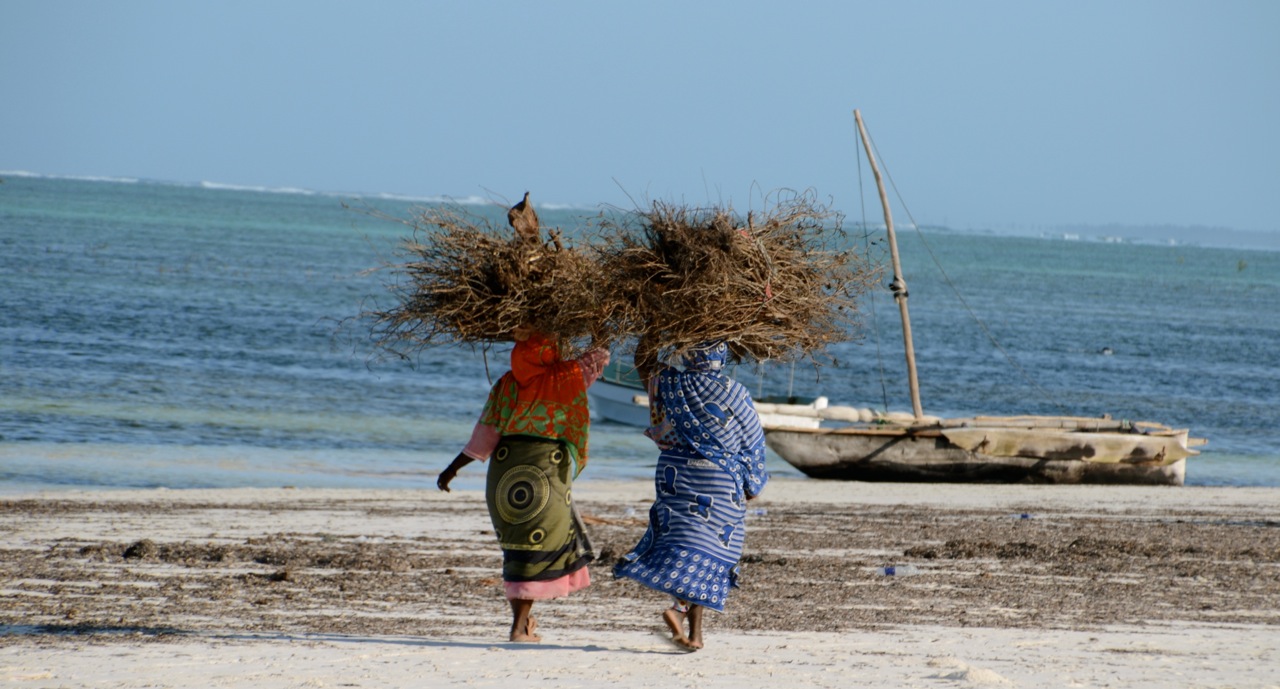
From above I noted dirt roads, palm trees, and hundreds of square silver tin-roofs checkered with rusted red panels. Within an hour we were in the back of a taxi driving at a remarkable speed across the island. I saw that beneath the rusted tin roofs were mud huts, between which ran barefoot children, goats, cows and chickens. Women, every single one of them covered head to toe in colorful fabrics (Zanzibar is largely Muslim), heaved buckets of water and bundles of sticks and babies.
Almost immediately I felt what I should have anticipated if not for my own naivety. Eyes. All of them looking at me through the open window of our taxi as it slowed through villages. It was a sensation that would continue throughout the week and one I would not get any more used to. Their looks were not judgmental or unwelcoming or cruel. They were simply the kind of look one gives to anything that is noticeably different.
I am white, and not just a little bit – a thing I’d never given a moment of thought to. My skin is white and my hair is white and my eyes are white and my smile is white. The invisibility I felt in Italy (and America, really), would not be mine in Africa.
We stayed on the northeast end of the island on a quiet beach where the very few vacationers who walked it were largely outnumbered by the local people who fished the calm turquoise waters and the children who engaged in organized soccer games each evening.
It was there that I first observed that Zanzibar is a series of juxtapositions. The ocean boasts gorgeous, exotic even, natural beauty while in the village just 200 meters away a layer of garbage lines the dirt streets. I enjoyed running water in my hotel room while next door women carried buckets from the single village spigot. Each day we were driven to or from a leisure activity of our choice (scuba diving, a visit to the national park, etc), en route passing through villages abuzz with everything except relaxation. People drove hoes into rice-paddies, carried cumbersome bundles of dried sticks to fuel their cooking fires, hammered tin roofs atop houses, hauled crates of fruit to be sold at roadside stands. The children – none of them wearing shoes – played in the dirt along the road. Babies sat beside goats that rummaged through garbage. A little boy kicked a soccer ball that had become so deformed it bounced unevenly like a football.
It was my initial impulse to feel sorry for them. They need shoes! Running water! Tractors! Or, at the very least, that boy needs a new soccer ball.
The afternoon we arrived I met our hotel’s owner, Jahn, a large Finnish man with the eyes of a basset hound.
At the small outdoor bar I talked to him about the island’s villages and people – feeling desperate to better understand everything I’d seen.
“What do people do here – what is the economy?” I asked him.
“Nothing. There isn’t one.” he said, explaining that 85% of the people on the island have no reliable source of income.
Jahn spoke with a trace of bitterness, which I soon learned was more than founded. Having dedicated the majority of his adult life to helping humanitarian efforts in impoverished countries from Bosnia to the Congo to here in Tanzania, he’s seen government corruption first-hand, ultimately resulting in the demise of his labors of love (hospitals and schools).
“It’s like pee in your pants,” he said to me. “It starts out nice and warm, then quickly turns very cold.” I sat beside him and nodded solemnly, as if I knew all about government corruption (as it turns out, I don’t at all).
Over the course of my five days in Zanzibar, I interacted mainly with the 15%. I’d argue that if anything, Zanzibar’s economy is people like me. Tourism was something not easily accepted by the people here, and it’s still not well liked today – at least not by the 85% who don’t benefit from it. It was explained to me that resources on the island are scarce as it is. The villages sometimes run out of water from the same source that is used by our hotel (which, I’m certain, does not ever want for water). I instantly felt guilty for having run the shower long enough to shave my legs the night before. I just didn’t know.
It’s no wonder oblivious tourists like me aren’t loved here. This knowledge hung with me throughout my time in Zanzibar. Even when I probably wasn’t, I felt frowned upon by the local people.
Tuesday was an assault on the senses.
Ali, a guide from the local village, took us to tour a spice farm, where my sense of smell (and knowledge of spices) was put to the test quite literally. I sniffed and/or tasted tamarack and lemongrass and peppercorn and cinnamon and clove and cardamom and ginger and vanilla and about another half dozen plants I can’t recall. I guessed maybe a fourth of them correctly.
Located on the top of a small hill, jokingly described to me as the “Mt. Kilimanjaro” of Zanzibar, the spice farm looked like no farm I’d ever seen before. Instead of even rows of crops, the spices and fruits grew will-nilly in between towering palm trees. An unsuspecting wanderer might think it nothing more than an overgrown forest, and yet it contributes to one of Zanzibar’s core exports.


Following the spice farm, we drove into Stones Town, Zanzibar’s one and only city, where my sense of smell was put through the ringer once again. Ali lead us through a market, starting with the fish and meat section. A long narrow cement room was stuffed with men – all men – chopping and gutting fish in the gagging humidity. I walked by one man who sat listlessly tenderizing a large octopus, then another who took a hatchet to the backbone of a very large fish – sending chunks of guts and bones flying a few inches from my face.
Outdoors we ducked around rain that poured through holes in the sagging tarps that covered booths selling fruits I’d never seen before. We continued on through narrow alleyways, slogging upstream in rainwater that flowed around my ankles. Everywhere people wanted to sell me something; I said ‘no’ so many times that I finally stopped feeling bad about it. Ali lead us past what was once Freddie Mercury’s house and I pretended to look impressed (maybe I actually would have been if at the time I’d known he was the lead singer of Queen). We walked by a half dozen Mosques, each with a pile of sandals on the front doorstep belonging to the men who’d gone inside for the noon prayer. I saw a little boy wearing a red t-shirt with Obama’s face on the front of it. I smiled at him and he gazed up at me with that same long stare: I looked different.


At the end of the day, I was relieved to leave behind the concrete jungle of Stones Town and return to our peaceful strip of beach. There the days go through a full array of color and I relished in watching the transitions: At sunrise everything is kissed with gold before giving way to the brilliant shades of blue that last throughout the day. In the evening, everything fades to white. White sand and white sea and white sky. And finally pitch black dotted with silver stars so numerous that in places they look like a smear of light. It’s the sort of place that makes you feel like you’re on the very edge of the world.

On our last night I stood on the beach, sand the consistency of talcum powder squishing between my toes, and thought back to Jahn’s words that day we arrived. Yes, it had become clear to me that Zanzibar’s people are in need, though probably not for the the things I’d originally thought. Not for round soccer balls and shoes, anyway. It would take me far more than five days to understand the complexities of life and poverty and bureaucracy here. But in my short time I was able to acknowledge and appreciate the brighter side: there is a gorgeous simplicity to life on the island. It’s people are prideful, and for good reason.
Zanzibar has stolen my heart and opened my eyes. What I’d desired before, that thing I could only term as ‘different,’ was this unique combination of natural beauty and social awareness. It is refreshing to feel uncomfortable for reasons beyond my inability to properly pronounce Italian salutations or my misunderstanding of Paris’ restaurant etiquette. Zanzibar is where this adventure (can it be called that?) has transitioned out of being an extended holiday and into to an opportunity for expanded perspective. This, too, is a luxury. I am blessed to view a feeling of discomfort and challenge as something to be desired. Something worth ‘writing home’ about.
(For photos from Zanzibar, click here)


 Somewhere Seeking
Love it! Glad you were able to make it to Zanzibar!
Stacy, I’m here with your grandfather and read him your beautiful and insightful blog. He so enjoyed sharing your adventures through your writing and photos. It really makes him very happy you and David are on such a chance of a lifetime adventure. We’ll look forward to your next chapter and photos. Take care.
Amazing stories and pictures!