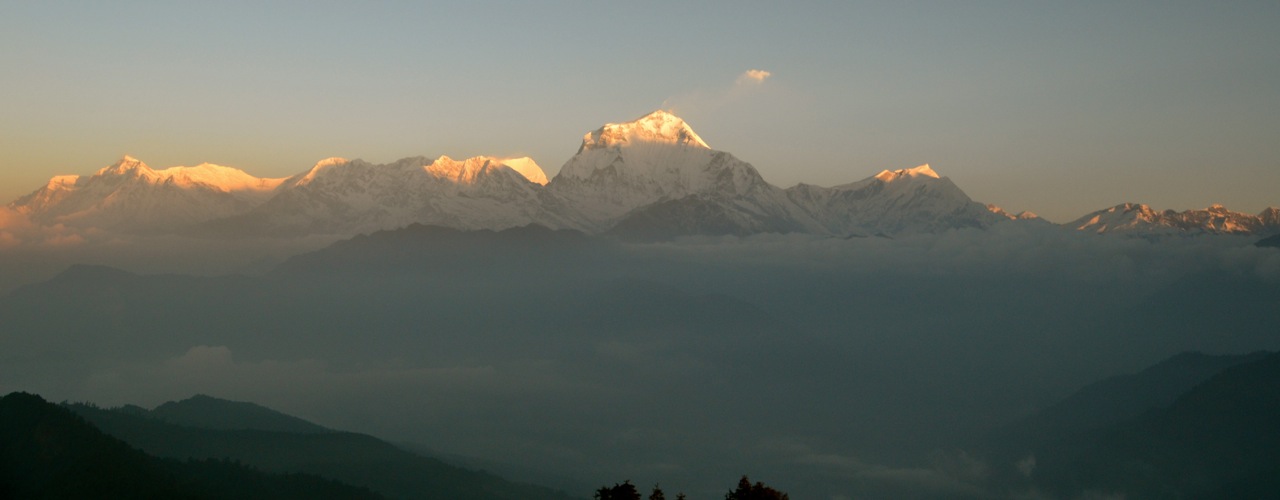
I’ve seen mountains. The Tetons and the Sawtooth. The Rockies and the Sierras. The Cascades and the Alps and the Andes. I’ve hiked them and I’ve camped in them and I’ve skied them and I’ve admired them from afar so it’s from an educated perspective that I tell you this: the Himalayas are the most incredible mountains I’ve ever seen.
In the days leading up to our trek, I attempted to temper my expectations. I have a way of setting myself up for disappointment and I did not want that to be the case with the Himalayas. But my efforts proved unnecessary. My imagination was simply not wild enough to beat the real thing, a reality made abundantly clear not even two hours into the 7-hour bus ride that delivered us to our trek’s starting point. As we rounded a corner I spied through the fog a steep slope down which a pattern of terraced rice paddies cascaded like a waterfall. I let out a private gasp, I really did, because while I’d expected rice paddies – I knew they’d be there – I had not anticipated their beauty. I think it was in that moment that I felt I had fully arrived in Nepal.
Of the numerous treks available in Nepal, we selected ours based on length and the assurance of good mountain views. While a trek to Everest Base Camp can easily take more than two weeks, our loop would be accomplished in a little under one. That seemed like plenty of walking to me and by the end of the week it absolutely was.
We’d commissioned a porter and guide for our trek, an uneducated decision and one I came to regret a little. Not at all because of the porter – a man named Paughtum, my gosh he was a lifesaver, but because of our guide, Tulsi.
Tulsi is a wiry, bespectacled Nepalese man who was quick to laugh at every single one of David’s jokes – even those he did not understand. In the midst of each eruption of laughter (whose authenticity I questioned) Tulsi emphatically high-fived David, as if together they’d just accomplished a most unlikely coup.
Tulsi was not a bad guide, no, that was not the problem at all. It was that he was very good at his job and took it as seriously as anyone could. He was precisely the sort of guide a person would want if they’d never in their life stepped beyond the concrete corridors of Manhattan. And, I suppose in fairness, my clumsy fall two hours into Day 1 might have suggested I was that type. As I wiped what I tried to convince myself was not donkey dung from my face, Tulsi stated the obvious: “those rocks are very, very slippery when they get wet.”
Tulsi had a knack for dispensing unnecessary advice, such as his caution on night 1 about not drinking too much water before bed. I stopped him in the midst of his search for the english word “urinate” and said to him very seriously: “Tulsi, I’ve been drinking water my entire life. I know exactly what happens.”
Tulsi’s existence, I had to keep reminding myself, was our own fault. We’d asked for a guide because we thought we needed one, these were the Himalayas after all. But by the first evening I understood this just wasn’t the case. If you can read a map you can trek in Nepal. Extreme elevation and weather would add another element altogether, yes, but neither were things we’d be contending with that week.
Because I’d determined Tulsi’s services were not needed, I tried to convince myself he was just a nice Nepalese friend who was along for the ride. Someone to add a cultural flair to what might otherwise be a run-of-the-mill hike. But this proved increasingly impossible each time he jumped to help me replace my water bottle in my day pack or insisted that he bring up the rear of our small group – as if without him I might wander off trail and find myself a high cliff to step from. To say this irked me would be an understatement. Because I am an independent woman who does not like to be cared for but also because I’m innately irritable, I began to feel like a cat on a leash.
I endeavored (with varying levels of success) to not dwell on this detail during our trek and so I won’t do so here either. But let mine be a cautionary tale: if you are considering a trek in Nepal, take the porter, he’ll make your experience immeasurably more pleasurable, but skip the guide.
The mountains are dotted with clusters of ‘Tea Houses.’ Each with names like “Super View,” or “Excellent View,” and indeed they had them. These were where we stopped for midday meals of noodle soup and ‘Mo Mos’ (dumpling-type pockets of vegetables) and also slept each night. Part restaurant, part guest-house, they were every bit as primitive as I’d expected they would be. The electricity cut in and out and the showers ran either scalding hot or freezing cold but no place in between. The toilets were holes in the ground and the shabby bedrooms with their thin mattresses and mildewed ceilings felt no warmer than the outdoors: I could see my breath in some of them. The walls were thin enough that one night the snoring man next door seemed as if he was beside me in bed.
But at the end of each day when we trudged the final steps to our Tea House of that night, it may as well have been the Ritz Carlton because that’s how pleased I was to see it. For dinner I hungrily scooped fork-fulls of Dal Baht, a traditional Nepalese meal of white rice, vegetables and a brothy-lentil-soup sort of concoction which served to give the rice some flavor. Dal Baht was, too, what all of the porters and guides ate for both lunch and dinner, which accounted for their occasional boisterous chant on the trail: “Dal Baht Power, 24-hour, no toilet no shower!”


The last two nights of our trek saw us smack dab into the middle of Nepal’s second largest festival of the year: Tihar, “The Festival of Lights.” In addition to the lighting of candles on windowsills everywhere, this meant that each evening the village’s young people rotated between the Tea House courtyards with music and dance. This was entertaining at first. But when it carried on late into the night I began to think otherwise. On the second night I imagined myself climbing out of my carefully arranged sleeping bag, flinging open my plywood door and asking as politely as possible “could they please move it along?” It was what I would have done in San Francisco – it’s what anyone would have – but this was Nepal. They could chant and sing all night if they wanted to and perhaps they did, I’m not sure: at some point the noise lulled me off to sleep.
For two months I’d been without the friendship of a female.
David is as sensitive a man as they come, and I have many girlfriends back home who have generously remained in touch with me, but a girl in the flesh and blood has been, shall we say, lacking. And lacking was what I assumed it would continue to be (particularly in the Himalayas) but I suppose it’s often those places you least expect a thing to happen that it does.
On our first night, Tulsi was trying to teach us a card game in the freezing-cold dining room of the Tea House where we were staying the night. It wasn’t yet dinner time but outside the fog had climbed up out of the valley below and engulfed us so completely that it was nearly dark. Tulsi speaks fairly good English, but a major detail of this card game was clearly getting lost in translation. From the table next to ours, Noor, a young Dutch woman with short blonde hair, offered to fill in the gaps; it was a game she knew well. So she sat with us, played with us, ate with us and then the following day set out on the trail with us.


Noor was hiking to Annapurna Base Camp (“ABC”) alone (four nights and five days beyond our route). No guide, no porter. Instantly my inner competitor flared up. She may as well have been a fellow marathoner who, at the finish line, told me she was going to turn around and run back to the start. I envied her gumption and coveted her independence, too.
We took to one another instantly, Noor and I. Like an old friend, she folded easily into a pattern of banter with David, too, as we lovingly insulted each other over game after game of cards. As we walked we discussed the idiosyncrasies of various nationalities and also what we wanted to be when we grew up – a topic of conversation I’m convinced I’ll still be carrying when I’m sixty. I was disappointed to learn her family’s house in Holland was without a windmill, but she assured me that if ever I came to visit she would have a row of tulips planted. Her dad, she did say, wears wooden shoes on occasion and I was glad to have at least one stereotype justified.
She ended up spending three nights and days with us and, looking back, they were my favorite. I selfishly attempted to coerce her into abandoning her plan to hike out to “ABC,” and finish with us instead. She did the same to me, pointing out how incredible it would be to stand at the base of Annapurna together. But neither of us proved successful and on the fourth day we parted ways at the top of a mountain overlooking a deep valley with rice paddies that carpeted the slopes in even pleats. Later that evening when David and I reviewed our ‘high-lows’ of the day, saying goodbye to Noor was easily my ‘low.’
If my experience could be evident of the grand scheme of things, let it be known that the Himalayas are nocturnal creatures.
I awoke at sunrise the first morning to Tulsi tapping on our door and excitedly announcing that the sky had cleared: we could see the mountains. I looked out my window and sure enough staring back at me from what had been only a foggy abyss the day before was Annapurna South: big as life itself. I walked out onto the roof of the Tea House and took in the view unobstructed. Somewhere below me a rooster screamed its little lungs out and a dull clanging of bells tied to pack mules disappeared down the steep stone trail, which together served to make the experience that much more unique. This was not just a snow-capped mountain. This was a Himalayan snow-capped mountain.
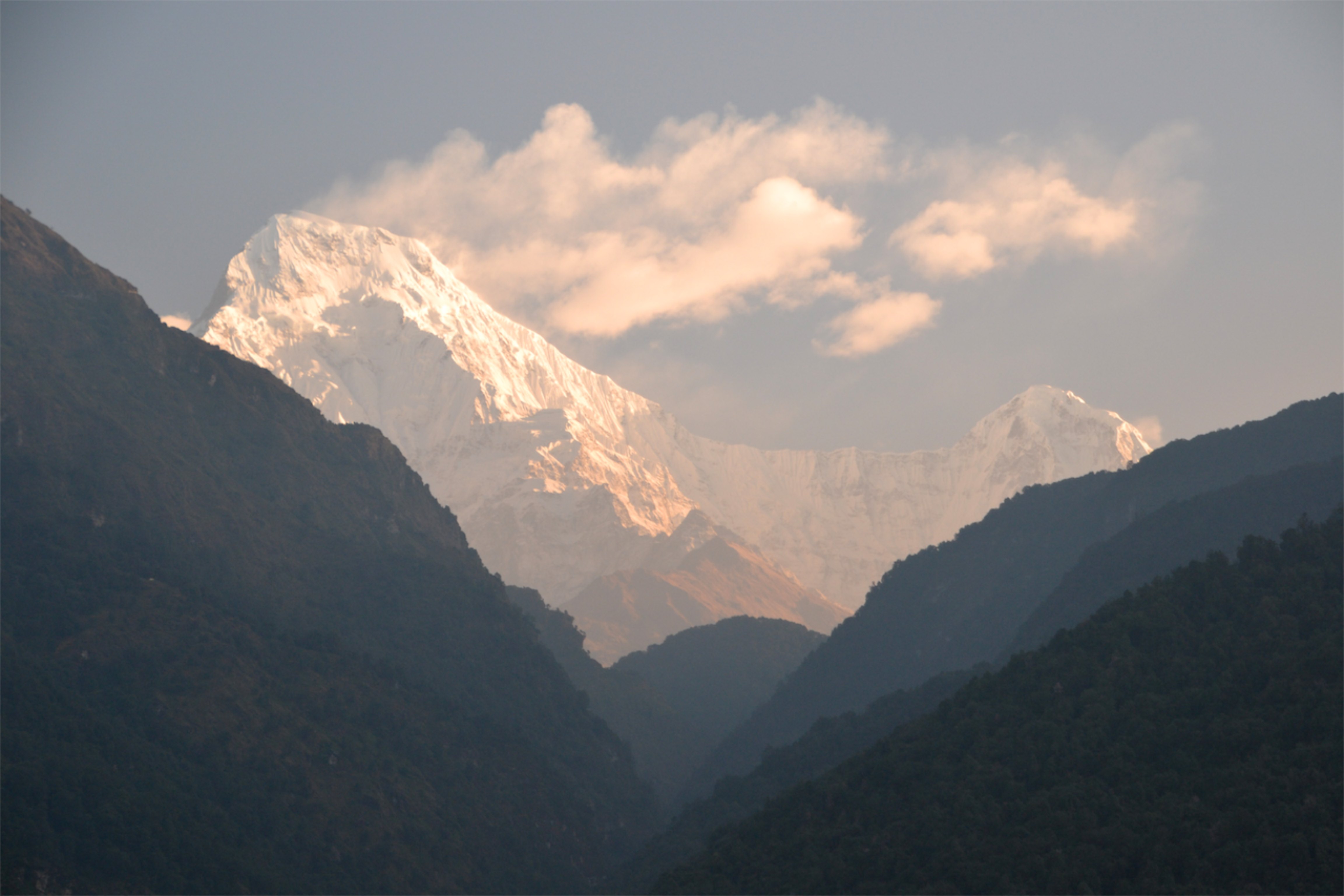
Such sitings became something I counted on each morning. Where the afternoon before I’d walked through fog so thick that even the low mountains became mere suggestions of mountains – like a pencil drawing that had been almost entirely erased, the mornings dawned crisp and vividly blue, revealing sharp white peaks that practically glowed like hooded ghosts. But by the time we finished breakfast, the fog would have climbed halfway up the mountains as if to tuck them in for a day of rest.
The most memorable of these mornings was our second, when we woke long before sunrise to a clamor that sounded as if our Tea House was being dismantled. Plywood doors opened and closed and trekkers trudged up and down the hallways in eager preparation for the headlamp-lit 1,000 foot climb to the summit of ‘Poon Hill.’ Like a glow worm we all wound our way up the steep steps, an effort that had me stripping off my down jacket only to quickly pull it back on once I reached the top where the air was so cold my toes quickly went numb.
I watched a ribbon of pink widen on the horizon, eventually lighting the tops of the Annapurna Range on fire. I could see forever, it seemed. We was miles from Mt. Everest and thousands of feet below its peak but I’ll tell you, there on Poon Hill I felt on top of the world.


The fifth day was, hands down, the hardest.
Exacerbated by the head cold I’d contracted and the fact that I no longer had the pleasure of Noor’s company, the trail that only ever went up or down suddenly seemed to do so with increased sharpness. We’d convinced Tulsi that we could be trusted to walk alone on this day and so in blessed silence David and I huffed and puffed up endless flagstone steps. While he listened to his iPod (a thing I cannot do when coordination is required – I’m the type who turns off the radio to parallel park) I tried to pass the time by mentally weaving a plot to another novel I’ll now procrastinate against writing. But my mind kept returning to a state of near certainty that I would be hiking for the remainder of my life. The climbs seemed to have no end to them. That morning we’d eschewed an opportunity for a short-cut to the end of the trail (perish the thought!) and I was beginning to regret having done so.
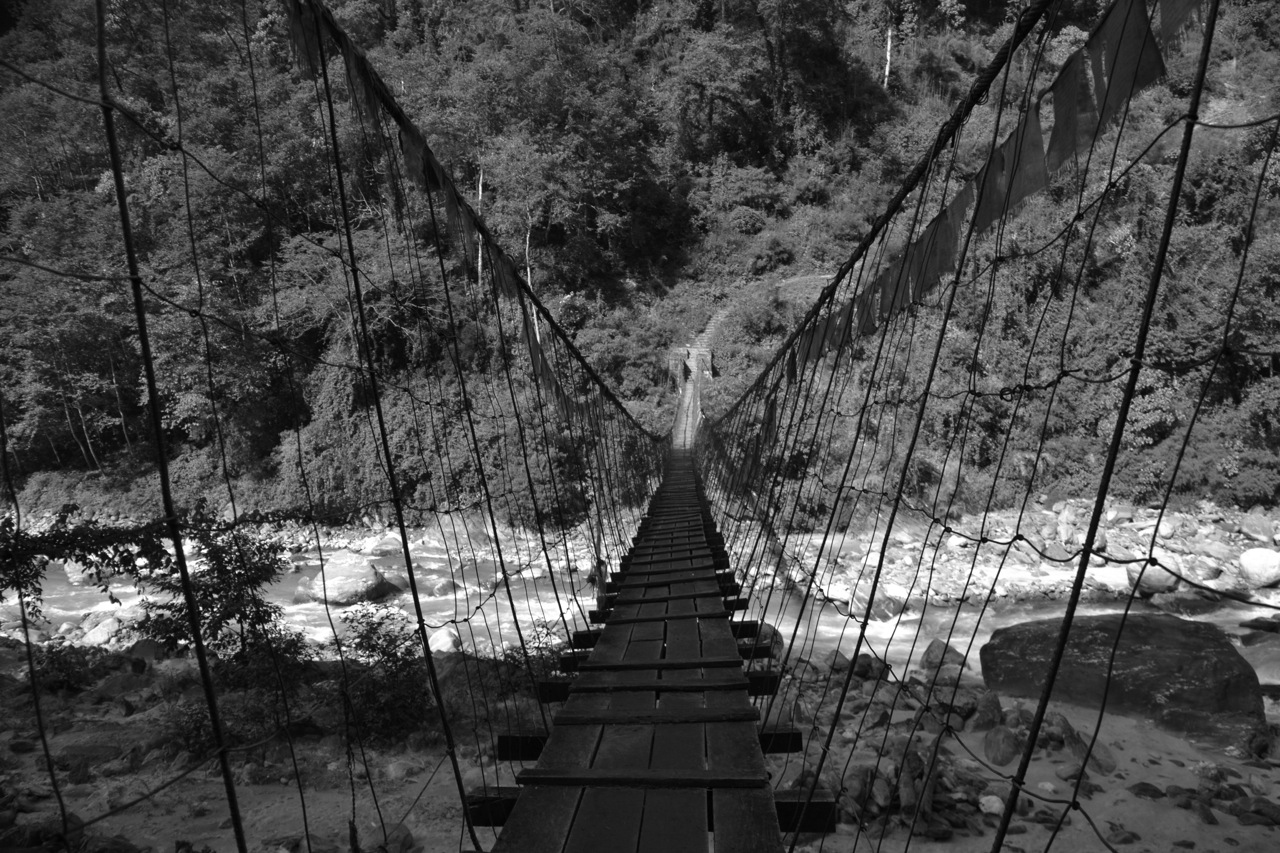
The trail that day included many shoddy (by my judgment) suspension bridges made of tired planks of wood and rusted cables. The first few I’d crossed with a pounding heart and a visible grimace on my face but by the time I reached what would be our last crossing that day I did so without fear. Let the bridge break and my legs with it, I decided. Anything to justify an airlift out. It was, after all, why I carried that traveler’s insurance.
But on a more sincere note, when, on the following day we did reach the end of the trail I high-fived David with a confidence that I could have done more.
“We could totally do ABC,” he said.
“Yeah, or Everest Base Camp,” I added and he agreed.
Remembering the nights I’d slept in my down jacket with a fleece shirt wrapped around my feet flexed like two cold, dead fish inside a rented sleeping bag I decided, in their own way, the Himalayas make you pay for a glimpse of them. But it’s worth it in spades. I suspect I’ll be back one day; the allure of an accomplishment that includes the word “Everest” remains a sparkly one in my mind’s eye.
For more photos from Nepal, click here.


 Somewhere Seeking
I am loving all of your posts! I can’t wait for the next one!
Amazing post Stacy! I love the blog and hope that Jason and I can join you on the next Nepalese adventure….in a few years 🙂