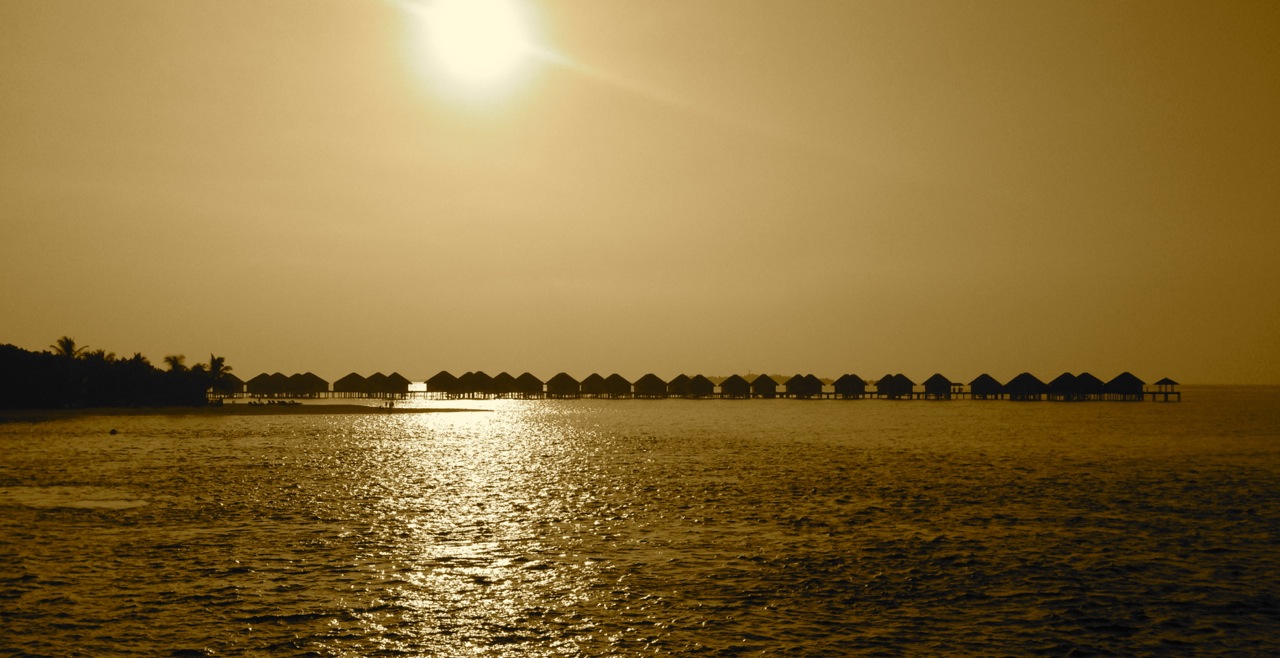
“You can call me Hiro,” she says to me. I’m standing in the sweltering open-air lobby of the Malé International Airport located on a tiny strip of land in the middle of The Republic of the Maldives. Hiro (short for Chihiro) is a petite Japanese woman holding a clipboard and sporting an enormous smile. She explains that she will be our dive instructor throughout our week-long scuba excursion and I take immediate solace in this fortunate turn of events. Never mind the spelling, that she answers to something akin to ‘savior’ is an excellent sign for an anxiety-ridden diver like me.
Half an hour later we’re stepping onto a drastically under-booked live-aboard boat set to tour the South Malé Atoll, a massive smattering of reefs that look like kidney-shaped swimming pools from the air. We make small-talk with the five other guests, briefly sharing our diving resumes, and I try not to feel intimidated by the young Irish couple who have brought their own dive computers and masks. Anyone who owns their own dive gear has surely surpassed those early-stages of paranoia that plague me on each dive.
I have a theory about death, and it’s that I’m never more than arm’s reach from it. Perhaps this is a morbid way to view life, but if you actually think about it: it’s true. Strapping an air-supply to your back and diving sixty feet below the surface of the sea is an excellent way to push your luck on the death-front, and for this reason the act of scuba diving has always unnerved me. There have been times when I’ve relaxed enough to admire coral and clown fish – but for the most part, diving is something I survive. Each time my head breaks the surface of the water at the end of a dive, where some might exclaim over having seen such and such, I’m most excited simply to be alive. Which is, arguably, a more meaningful observation, but certainly not the intended.
The Maldives, I tell myself, will be where I turn a corner. We’ve decided to pursue advanced certification in addition to the already-scheduled 12 dives and I’m hopeful that the incorporation of a textbook will give the experience enough of an academic slant that my familiar fears are assuaged. But before I’ve dropped into the water for our first dive, Maureen, the Irish woman is screaming from a jellyfish sting on her leg. This is enough to have me pulling off my fins except there’s Hiro in the water, coaxing me to the edge of the boat. We’ll descend quickly, it will be okay, she assures me and for whatever reason I trust her. I extend my legs in a giant stride and land in the water with a clap. Together we sink, me flinching at the tiny translucent jellyfish that float near the surface. I make a mental note to request a full-body wetsuit on the next dive. Despite that the water is the temperature of a tepid bath, the short-sleeved suit I’m wearing leaves far too much surface area for those nasty little creatures to rub up against.
We’re down about twenty meters and I’ve just achieved a pattern of even breathing enough that I’ve admired a sea creature or two when the ocean tries to swallow us whole. Out of nowhere I’m suddenly engulfed in a swarm of bubbles and before I realize what’s happening, David is clinging to a chunk of coral with one hand and grabbing for mine with the other. Above us a handful of divers from another party are struggling to find similar handholds in the reef and Hiro is retrieving a fourth diver that has gotten picked up in the bursting current.
For more than a minute we hold on while the ocean rages with a force I’d only ever experienced on its surface. Feet above our heads, we must look like Helen Hunt and Bill Paxton in Twister and I think to myself that this is what it feels like to be in somebody’s stomach during a bout of intense indigestion. Surely the world is ending right here and now.
Then, as suddenly as it began, the force subsides and we loosen our grip. Motioning with a flat-hand, Hiro indicates that we should stay as close to the reef as possible and she leads the way, pulling against a current that is still strong but predictably-so, with carefully-placed handholds in patches of exposed rock. I’m waiting for her to signal for us to ascend – certain that it’s the only reasonable action to take in a situation like this, lest the ocean choose to digest us completely. With wide eyes I follow her giant blue fins as we work our way around the corner of the reef and this is where the current all but disappears. There is no emergency ascent, which would suggest there isn’t actually an emergency either – but it’s not until forty five minutes later when I’m back in the boat that such a possibility occurs to me.
I’m peeling off my wetsuit and Hiro is smiling wide. Did we enjoy the dive? I think she must be kidding. She concedes that yes, it was a very unusual current. A ‘washing machine,’ she calls it, but she shrugs off the whole thing as relatively commonplace. In my diving history (short as it is) I’ve never experienced even a very light current and I’m suddenly not so sure that I’m cut out for The Maldives. The serenity its known for above water is just plain misleading.


But after lunch I’m on the dive boat again – this time stuffing myself into a full wetsuit. While I can’t guard against this unusually strong current, I’ll control the factors that I can and I’ll be damned if I get stung by a jellyfish.
Famous last words? Yes, of course.
Fifteen minutes later I’ve achieved neutral buoyancy and am studying a tiny black-and-white striped fish while it loops through spindly blue coral when it suddenly feels as if someone’s driving a nail into my right ear. Tears burn my eyes inside of my plastic mask and I’m screaming into my regulator because the shockingly piercing pain will not subside. I flail my hands erratically around my head, sure that I’m being attacked by a fish with razor-sharp teeth but nothing is there. What I later learn was a stringy jellyfish tentacle has drifted away as discreetly as it came. Later, on the boat, while Hiro spritzes vinegar onto my ear I suggest to David that we skip the third dive scheduled for later that afternoon.
In fact, the whole thing’s enough to keep me on dry ground for the remainder of the week except that David has the good sense to suggest I’ve gotten all of my bad luck out of the way. I’m a real sucker for superstition and it’s a good thing because from here on out The Maldives and I maintain a truce. I fall in love with her pods of dolphins that soar alongside our dive boat. I adore her sea turtles that systematically scavenge the gentle sloping reefs. I’m in awe of the flocks of eagle ray, one of them 21-strong, that glide elegantly in formation above poker-faced sharks that pace back and forth, keeping me on the edge of exhilarating panic. At times it all come together like a visual symphony – large schools of silvery blue fish shooting by like the string section, parting to reveal a giant grouper that putters along like a tuba’s deep baritone.
With the currents, I make peace. They are a constant here in The Maldives and soon I gain enough confidence that I’m riding them with the smoothness of a seal. At surprising speed, I drift over forests of coral – my childhood fantasy of flying like Peter Pan seeming not as far-fetched as I’d been lead to believe. In fact, navigating the currents becomes a thing I look forward to – an almost athletic element of an activity I’d previously perceived as relatively passive.


On the fourth night we submerge ourselves into pitch-black waters illuminated only by the light from our waterproof ‘torches.’ The sea is asleep in the truest sense of the word – only the random yellow butterfly fish flits about while we hover over tangles of coral and spot fish that sleep on its branches like wet socks laid out to dry. The fish don’t make any more of a sound during the day, but somehow it all seems quieter at night. Certainly more peaceful. And the expanse of sea life having shrunk to only what can be seen in the circumference of my flashlight’s beam, I achieve a new kind of focus that has me noticing the tiniest of details. My attention is held so completely hostage that we’re more than halfway through before I remember that diving at night, much like sinking to the depth of 100 feet as I’d done earlier that day, had been a long-standing fear of mine. Tick and tick.
Thirteen dives later, having proven sufficient diving prowess, Hiro awards me advanced certification, a thing whose very purpose is to spawn more dives at depths that previously scared the living daylights out of me. And while I’m excited to put this new certification to use, I know it will be difficult to surpass my experience here in the Maldives. Even more impossible will be topping Hiro, whose measured reassurance whenever my brow so much as furrowed got me through moments of panic both under water and above.


 Somewhere Seeking
Lovely pics 🙂
Thanks MaldivesDreamer! It’s an easy place to take them 🙂